Bringing cultural awareness to caregiver stress in the Hispanic community


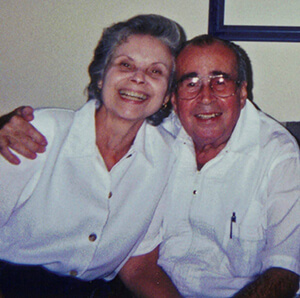
Roger Gonzalez’s mother, Nelida, was diagnosed with Alzheimer’s in the mid 1990s. Sadly, the stress of caregiving deeply affected Roger’s father Angel. After both parents passed in 2003, Roger turned his grief into action, becoming a volunteer and raising over $70,000 for the Alzheimer’s Association. His mission today is to ensure no caregiver suffers in silence, encouraging others to seek support and take care of their own well-being.
Cuban beginnings
Nelida Gonzalez was born in 1932 in Cuba. There she met her husband, Angel, and the couple were married in the mid 1950s, having their first son, Al, in 1959. Because of political turmoil in the country during this time, Nelida and her family fled Cuba and eventually settled in North Carolina.
Prior to arriving in the United States, Nelida was a teacher in Cuba. Wanting to continue to teach, Nelida earned her master’s degree in 1970, shortly before giving birth to her second son, Roger. Later, Nelida would go on to teach high school Spanish.
“She was very happy, loving and caring,” said Roger. “She was laughing all the time and looked at the bright side of life. Ironically, holding on to memories was a big thing for her.”
Living with Alzheimer’s
When Nelida began to show signs of Alzheimer’s in the mid 1990s, Angel was the first to notice. At the time, Roger was living across the country in California. He noticed his mother would ask the same questions whenever she would call.
By 2000, Roger decided it was time to leave the Air Force and move across the country to be closer to his family. “I moved an hour and a half away,” said Roger. “My dad was still the [primary caregiver] and my brother was second because he lived nearby. I came home every two to three weeks, staying overnight for the weekend. I noticed diminishing cognitive abilities in her which was sad.”
While Angel and Al handled the day-to-day caregiving requirements, Roger was able to help out with other tasks. He would run errands, fix things around the house but most importantly, he would spend time with his mom giving his dad a much-needed break.
Traditional Latin American household
Alzheimer’s isn’t uncommon in the Hispanic community. Approximately 13% of Hispanics who are 65 or older have Alzheimer’s or another dementia and are 1.5 times more likely to have dementia than Whites. Fifty-seven percent of Hispanics believe that significant loss of cognitive abilities is a normal part of aging.
Angel grew up in a traditional Latin American household where women were responsible for cooking and cleaning while the men worked. Never having learned to cook, when Nelida lost the ability to do so, the couple began to eat canned soup and toast every day.
For some in the Hispanic community there is a stigma around asking for help. Angel didn’t want to burden his children and never felt comfortable reaching out to anyone for help. “We tried to talk him into a support group but neither one of us took the reins to go out [and find one] for ourselves,” said Roger. “[He believed] his job was to take care of his family. Every time we brought it up, he’d push back. We gave up after a while.”

Caregiver stress
Unfortunately, what Roger and his brother didn’t realize was how much stress their father was under. Alzheimer’s caregivers frequently report experiencing high levels of stress. It can be overwhelming to take care of a loved one with Alzheimer’s or other dementia, but too much stress can be harmful to both the person living with the disease as well as the caregiver.
Fifty-nine percent of family caregivers of people with dementia rated the emotional stress of caregiving as high or very high. Spousal dementia caregivers are more likely to experience increase burden over time which increases as the person with dementia declines.
Dementia caregivers were significantly more likely to experience depression and anxiety. The prevalence of depression is between 30 and 40% in dementia caregivers and depressive symptoms increase 30% if the caregiver is a spouse.
Roger said, “He talked about, how tough it was on him, and he used the word depression.”
Sadly, the stress of caring for his wife took a toll on Angel. Both Angel and Nelida died in 2003.
Caregiver resources
Despite the Alzheimer’s Association existing in the early 2000s, Roger and his family were unaware of the organization and the support groups available to caregivers like Angel. Today Roger sends everyone he meets to the Association website, alz.org, to find out more information.
There they can find resources not only on the disease but also on ways to support caregivers. The website includes an entire section on caregiver health, including sections on both stress and depression. Additionally, caregivers can call the 24/7 Helpline at 800.272.3900 to connect with a live person who can provide information, local resources, crisis assistance and emotional support.
“A support group sounds obvious, especially now a days,” said Roger. “There is so much stuff on the Association website, so many ideas, things people didn’t know existed. I’m sure there are online communities. They can look [and see] they’re not the only ones dealing with this, [Alzheimer’s is] common.”
Volunteering for the Association
After the death of his parents, Roger found the precursor to Walk to End Alzheimer’s, the Memory Walk. There he and his brother joined other people affected by the disease and raised funds in the hopes of finding a cure.
In 2008, after moving to the Bay Area, Roger signed up for his local Walk, Walk to End Alzheimer’s in Silicon Valley. However, this time, he decided to become a volunteer. He spent the next three years on the Walk Committee helping to put on the event in San Jose.
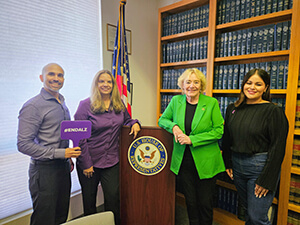
After three years, Roger was ready to take on a new challenge and became an Advocacy volunteer. He started off attending meetings, sharing his story and writing letters to the editor. Eventually he became the ambassador for Congresswoman Zoe Lofgren who represents California’s 18th district.
Today, Roger continues to help with the advocacy team. “I like being involved in the political process. I’ve been a minor political junkie for a long time,” said Roger. It’s something I’m interested in and care a lot about. This is a perfect way I can combine an interest and a passion on one side of my life to help find treatment and a cure [for this disease].”
Raising funds
Twenty-two years after the death of his mother, Roger continues to fundraiser for the Alzheimer’s Association. Despite raising more than $70,000 for Walk to End Alzheimer’s (as of the writing of this blog), Roger says he still feels awkward when he asks people for money. “It’s not my comfort zone, the whole fundraising thing,” said roger. “It feels awkward to ask for a donation. I have to ask long-time friends multiple times, but I know they’ll eventually donate. I keep at it.”
In addition to asking friends for a donation, here are a few other ways Roger is raising no less than $1,000 each year (but usually over $4,000).
- Posting a Facebook fundraiser
- Adding links to his fundraising page to online groups he’s a part of like NextDoor and Slack
- Asking a restaurant to donate a portion of their food purchase proceeds to Walk. Roger invites his friends to join him for a fundraising dinner at the restaurant
- Having restaurants donate items to raffle off
- Asking his gym to do a fundraising workout where people who joined are asked to make a donation
Supporting other caregivers
Roger continues to honor his parents by showing up for the Alzheimer’s Association. His hope is to make sure that no caregiver ends up depressed like his father. Roger encourages other caregivers to visit the website, meet other caregivers and to take care of themselves.
“Yes, were starting to get some useful treatments,” said Roger. “It’s one of the worst diseases. I want to do everything I can to prevent other families going through what ours did. [The Alzheimer’s Association is] a fantastic organization. There is so much helpful information out there and so many great people out there. Take care of yourself and whoever is providing care for the person who has Alzheimer’s.”
You can join Roger and his team, OTF Rose Garden, at Walk to End Alzheimer’s – Silicon Valley on October 11, 2025 at Lake Cunningham Park in San Jose. Not in Silicon Valley? Visit alz.org/walk to find a Walk near you.
For more information on Alzheimer’s in the Hispanic community visit alz.org/hispanicamericans.
Interested in becoming a volunteer? Visit alz.org/norcal/volunteers to learn more!