Finding purpose in the fight: Angel Smith’s journey as an Alzheimer’s advocate


Angel Smith of Salem, Oregon, spent years as her mother Hope’s primary caregiver before she ever thought of herself as an advocate. Now retired from the U.S. Army, she brings the lessons of that caregiving journey to her work with the Alzheimer’s Association®, advocating for world without Alzheimer’s.
A daughter’s long road
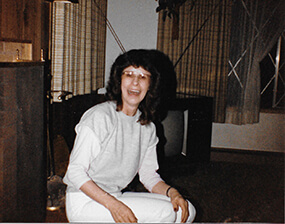
When Angel Smith looks back at the years she spent caring for her mother Hope, one thing stands out: she was figuring it out as she went.
Hope began showing signs that something was wrong around age 70. It was a close family friend who first raised the alarm.
The friend’s own father had Alzheimer’s disease and recognized the warning signs. “I’m just worried,” Angel recalled her saying. “Because this stuff isn’t like her. This is not normal.”
Angel reached out to the county’s Department of Aging Services, which sent someone out to evaluate Hope. The first visit caught her on a good day, giving the impression she was more capable than she actually was, which, in turn, limited the services she qualified for.
After working with the county, Angel was slowly able to secure more support for her mother. “I finally got it up to 40 hours a month,” Angel said. “I had somebody come check on her one or two hours a day, Monday through Friday.”
Despite the help, Angel was managing other aspects of her mother’s care like fighting with magazine subscription companies that were targeting seniors, catching a scam that had drained Hope’s checking account and eventually getting added to her mother’s bank account to protect it. At the same time, Angel was also in the key part of her career, trying to work her way up the corporate ladder.
Finding the right care
When Angel brought her concerns to Hope’s doctor, she was told it was normal aging, and that everything seemed fine. It was a good two to three years later that both Hope’s neurologist and social worker arranged for a formal assessment: a six-hour cognitive evaluation conducted by a psychologist.
The results were sobering. Hope scored below the bottom 1% for her age group. Sitting in the car afterward, Hope turned to Angel and said she thought maybe she just hadn’t understood the questions.
“Yeah, that’s kind of the point, Mom,” Angel told her.
With the diagnosis confirmed, it was clear Hope could no longer live on her own. Angel began the difficult work of finding the right care setting.
The first place she tried was not a good fit, and Hope ended up in a geriatric psychiatric unit while a Medicaid bed could be located. With the help of the staff there, they found Hope a permanent home in West Linn, where she spent her final years.
Angel visited constantly, often enough that other residents thought she worked there. She brought Hope milkshakes, took her for pedicures and made sure the staff knew exactly what her mother needed.
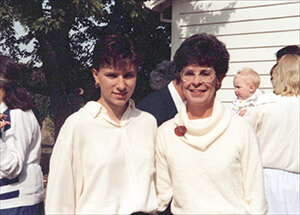
Hope died in 2018. She was, as Angel describes her, “a hard worker, an amazing human being. People loved her.”
Turning loss into advocacy
It wasn’t long after her mother’s dementia journey began that Angel connected with the Alzheimer’s Association. Her first involvement was attending a state advocacy day, where she met with legislators to advocate for Alzheimer’s care and research funding.
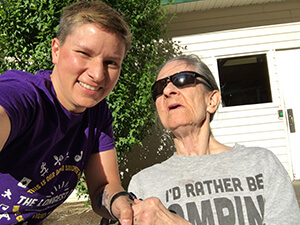
Now an Alzheimer’s Association ambassador, Angel has attended the Association’s National Advocacy Forum for two consecutive years, traveling to Washington, D.C., to meet with legislators and make the case for Alzheimer’s care, support and research.
She is also candid about why advocacy matters beyond any single family’s experience.
“We want to help other people not have to struggle and fight as much as we did,” she said. “The ultimate goal is one day cured.”
Her favorite part of advocacy is the community it creates.
“I think everybody gets something out of not feeling alone in dealing with this stuff,” she said.
For Angel, advocacy is also about paying something forward. When someone comes to her, overwhelmed after a diagnosis, she points them toward the resources that helped her most.
“I would point to the Association website, alz.org,” she said. “If you don’t know what to do, you’re tapped out, you just don’t know what you should be doing, whatever your question is, call them.” The Alzheimer’s Association’s 24/7 Helpline (800.272.3900) connects people with information and support at any hour, in more than 200 languages.
A voice for the LGBTQ+ community
Angel also brings a perspective that is not always apparent in dementia caregiving conversations. As a member of the LGBTQ+ community, she has become someone others in the community seek out for support.
Angel and her wife regularly visit her wife’s parents at the care setting where they now live. Through those visits, Angel has gotten to know several LGBTQ+ residents who approach her quietly, looking for connection.
“They don’t have a community,” she said. “And it’s hard for them.”
Angel is also candid about a challenge LGBTQ+ caregivers sometimes face, one that people rarely talk about: a parent whose dementia causes them to forget years of growth and acceptance, going back to an earlier time before that understanding existed.
“If you’ve gone through the hard part and your parents are super accepting and everything’s great, and then they forget all that and they go back to the not liking it, I can imagine that is hard,” Angel said.
“You just got through all this hurtful stuff and you thought you were on the other side of it, and then they forget.”
She was fortunate, she says, that this wasn’t her own experience with Hope. But she speaks openly about it because she knows others are carrying it quietly, and she wants them to know they are not alone.
Why she keeps showing up
Angel carries her mother’s memory with her, literally. She and her brothers, along with two nieces and a nephew, share matching tattoos: the word “Hope” alongside a purple ribbon and a forget-me-not flower.
It is a reminder of where her commitment comes from. When Angel sits across from a legislator making the case for Alzheimer’s research funding, or answers a late-night call from someone who doesn’t know where to turn, it is the reason she keeps showing up.
“We want to make it easier for them, make it smoother and hopefully make it something that can be treated,” she said.
Those interested in getting involved can learn more about becoming an Alzheimer’s Association advocate or attending the National Advocacy Forum. Volunteering with Walk to End Alzheimer’s is another way to make a difference in the fight against Alzheimer’s disease.