From guardian to champion: how one volunteer is helping end Alzheimer’s


Joey Yourchek didn’t set out to become one of the most dedicated volunteers in the Pacific Northwest. It started with a client, a woman with Alzheimer’s disease who changed the way he saw everything. “I stumbled across the Alzheimer’s Association® going, ‘Oh, well, apparently there is [help] and I just didn’t know about it,’” Joey said. Now, he’s making sure no one else has to feel that way.
A life changed by one client
Joey spent his career doing guardianship work, helping people who needed support with finances, legal decisions and daily life. When he was appointed guardian for a woman living with dementia around 2017, something shifted for him.
She had been written off by others who said she was confused, that she couldn’t understand things and that she should be placed in a care setting and forgotten about. But Joey didn’t like this idea and wanted to do more for her.
That moment changed him. He started learning everything he could about Alzheimer’s disease and helped this woman find a place back in Manhattan where she was from.
It was during this experience that a friend of Joey’s, who was also on the Alzheimer’s Association Oregon & SW Washington chapter’s Board of Directors, introduced him to the Association.
Jumping in and never looking back
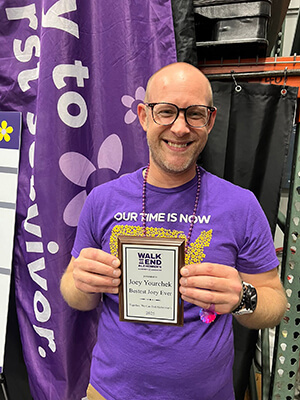
Joey got his start through what was then known as The Longest Day®, now rebranded as Do What You Love to End Alzheimer’s™, and quickly became deeply involved with the Association. He joined the chapter’s Board of Directors, helped plan the Memories in the Making gala and eventually became the go-to person for volunteer coordination across multiple Walk to End Alzheimer’s events.
Today, Joey serves as the Event Experience Chair, which he describes simply as “logistics.” He manages volunteer recruitment, organizes sign-up sheets and makes sure everyone is ready to go on Walk day. Because of his success with Walk to End Alzheimer’s – SW Washington, WA, Joey now helps with Walks in Portland, Bend, Corvallis and Eugene too.
Joey said, “I kind of ended up being the volunteer guru, I guess you could say.”
Walk to End Alzheimer’s SW Washington
Walk to End Alzheimer’s is the world’s largest fundraiser for Alzheimer’s care, support and research. As a member of the Walk Committee, Joey’s day starts before the sun comes up.
But the most powerful moment of the whole day isn’t setting up the banners or organizing the volunteers. It’s watching what happens when the event begins.
“My favorite thing is just seeing the joy that people experience when they are there, especially when the ceremony happens,” he said. “And you have all those people just standing there. I think it’s just a very impactful experience.”
Pride Month: Alzheimer’s and the LGBTQ+ community
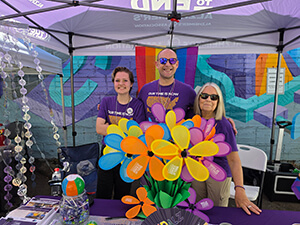
This June, during Pride Month, it feels right to shine a light on Joey, who identifies as gay, and on the unique ways Alzheimer’s disease touches the LGBTQ+ community.
While Joey doesn’t have a personal connection to the disease, he understands the challenges the LGBTQ+ community faces when it comes to Alzheimer’s and dementia. These include finding inclusive and welcoming health care providers, less ability to call upon adult children for assistance, concerns about stigma and higher rates of poverty and social isolation.
Through his own work in aging support services, Joey highlights the importance of health care power of attorney, something especially important for the LGBTQ+ community.
“I’m promoting it to those adult orphans and people who may not have someone they could designate,” he said.
You are not alone
In addition to education programs and support groups, the Alzheimer’s Association offers a 24/7 Helpline (800.272.3900) which is free and available in more than 200 languages.
“There are certainly plenty of support systems out there and resources,” said Joey. “That Helpline [the Association has], I’m telling people, if you have a concern, call it. If it’s two in the morning, call it. That’s what it’s there for.”
Why volunteering matters
Volunteers are the key to making a difference in the lives of people facing Alzheimer’s and dementia. If you ask Joey what he gets out of it, the answer comes quickly: it’s the chance to spread awareness.
“I would definitely tell them that it’s a no pressure obligation,” Joey said. “Do what you can, when you can. If you have the same passion for helping to support an organization that is on a mission to find a cure, you should volunteer.
“I would much rather get people to feel energetic about such an important cause and have fun doing it. Knowing that you’re doing such a good thing for your community. You should volunteer because you’re helping support an organization that is on a mission to find a cure. That’s the long and short of it.”
Want to get involved? Joey’s advice: just start. Sign up to volunteer or register for Walk.