“Teenager things” not always possible when a grandparent has Alz


Today marks the last of our National Caregivers Month blog series. I hope you’ve learned a lot and taken steps to seek support and help. A huge thanks to all of our amazing caregivers who go above and beyond to support our Alzheimer’s community!
I’m going to leave you today with a few words from Jaimee, an 18-year-old high school senior in Reno, Nevada who helps take care of her grandmother, who has Alzheimer’s disease:
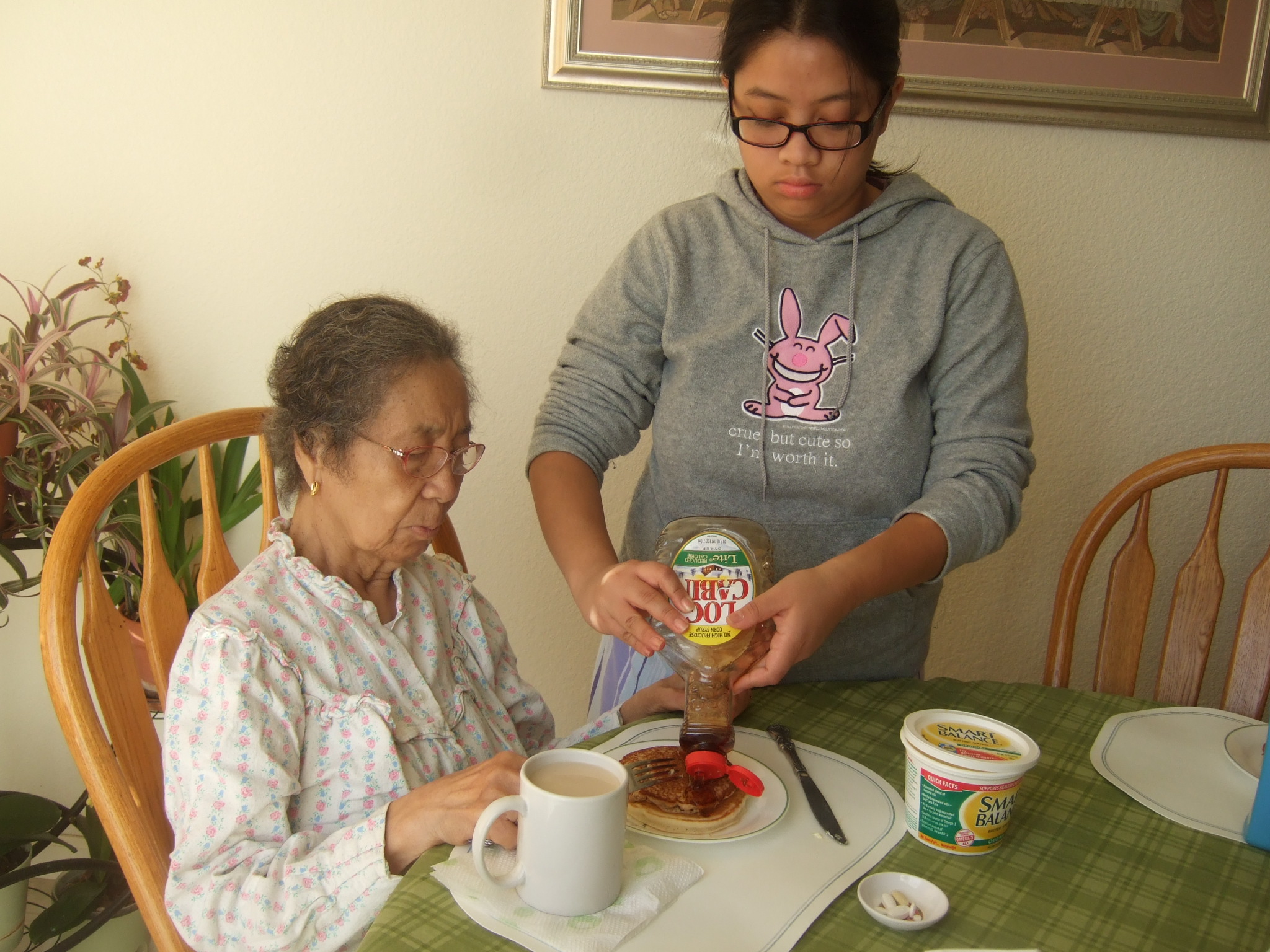
Jaimee helps her grandma with breakfast
When I was 15-years-old, my maternal grandmother was diagnosed with Alzheimer’s disease. My maternal grandmother has always been in my life as she took care of me. Growing up, I watched the afternoon soap operas with my grandma. Between these operas would be advertisements on medicine to treat the symptoms of Alzheimer’s disease. The understanding I had of Alzheimer’s disease was a loved one forgetting a name. However, a day in February 2009 changed everything I knew about this disease.
When my mom told me the news about my grandmother, it wasn’t the easiest thing to comprehend. I had started high school and it was a time to figure out what I want to do in life and still do normal teenager things. I wanted to hang out with friends, go out to movies, go to the school dances, and just have fun as a teenager. I wasn’t going to let my grandma’s disease bring me down. I told myself to look positive. However, there were times when my mother was taking care of my grandmother that I wasn’t able to do things I wanted to do. There where many times I lacked transportation to activities because we were learning how to take care of my grandma. It developed a change in lifestyle.
At first, I only wanted to use my knowledge of the disease to cope with this. However, it wasn’t that easy. On my mom’s suggestion I went with her to classes that offer information about how to take care of a loved one with Alzheimer’s. Going to this class, I was really fascinated by all the health effects with Alzheimer’s disease. It really helped my understanding of this disease and it is interesting because there is so much information on how to become a caregiver.
Because of my experience in the classes and the connections I made, I wanted to do something more for the Alzheimer’s Association. I signed up to participate in the Walk to End Alzheimer’s that year and I loved the experience. I started speaking with people and bringing more awareness of the disease. Over time, I have come to consider myself an advocate for Alzheimer’s disease because of its impact on my life and the experiences I have had. I want to help other people, mostly people close to my age and let them know they are not alone.
My grandmother is my second mother and I would do anything to help her. This experience has changed my life and I look forward to years to come.
Don’t forget to share your experiences here, on our Facebook page or at www.alz.org/nadam. We want to hear from you!






I was 14 when my dad was diagnosed with onset Alzheimer and my younger brother was 10. I am 17 now and losing someone to Alzheimer is the most painful thing I’ve experienced because no one my age could even fathom the emotions i felt. Mood swings, crazy anger, loneliness, grieving, fighting. The disease disrupted my youth and changed everything i knew. I watched the person i loved the most in my life deteriorate into a blank stare with no reply to my attempts to create conversation. My Dad no longer remembers my name, my brother, or my mom. Ive had to wake up heartbroken everyday since the first day of high school. Dealing with the repercussions of a new school, feeling different, and my father all warped my reality into a gloom environment. How many teenagers do you know who can say their parent lives in a nursing home. How does a 17 year old say that to a girl he has feelings for, or to a teacher when you don’t do your homework. It tore my family apart and it took up until now to realize i need to improve relations