The invisible threads of care: Navigating dementia from thousands of miles away


This is the second installment of a two-part series on long distance caregiving. Please check out last week’s blog to learn more about Mr. Sen Gupta and his diagnosis.
Nita Sharma, a long-distance caregiver for her father in India, shares her experience of managing his care while living in California. She reflects on the strategies she used to stay connected when she couldn’t visit, as well as the steps she took during her visits. After her father’s death in 2021, Nita connected with the Alzheimer’s Association and will soon be facilitating her own support group, Caregivers Across Boarders, starting in February.
A dementia diagnosis
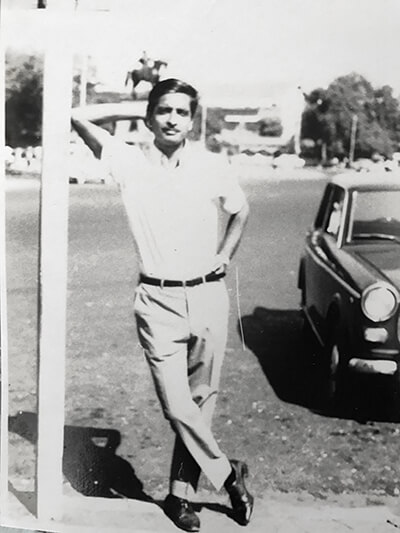
Mr. Ashoke Sen Gupta had an amazing memory. Growing up in what is now modern-day Bangladesh, he was always first in his class. He could tell fantastical stories that entertained not only his own children but also strangers on the train. He was known to go above and beyond for people and even turned his own home into a zoo when his U.S. born grandchildren came to visit.
When Mr. Sen Gupta was in his 70s and started showing the signs of dementia, his family dismissed it, thinking it was most likely old age, despite a family history of the disease. When Mr. Sen Gupta began to complain about headaches he was taken to the doctor and was eventually diagnosed with vascular dementia.
At the time of his diagnosis both of his children had moved far away from their family home outside of Kolkata, India. His daughter, Nita Sharma, lived in the United States and his son was roughly 2,300 miles away in Delhi, India. This meant that the bulk of the caregiving would fall to his wife.
Still wanting to help, Nita and her brother provided as much care support as possible from afar.
Setting up her father’s home
Nita first reached out to her cousin, who lived in Kolkata and was a doctor. Her mother (Mr. Sen Gupta’s sister) had recently died with the disease. “She became our local lifeline,” said Nita. “She had walked this path already and as a doctor, she brought both knowledge and calm when we needed it most.”
Next, she collected financial and legal information. Because Mr. Sen Gupta was the person responsible for this area of the household, it was important that this information was passed on to another person in the event Mr. Sen Gupta can no longer recall it.
They included their father in the discussions as much as possible, especially when it came time to discuss where he’d like to live. “Initially we had a candid discussion with my father,” said Nita. “What about long term care? It won’t be possible for our mother to do everything. He said, ‘No, I don’t want to move to a [care setting], so staying at an old age home, or a care facility was not an option. We had to prepare the home, make it safe place for him to stay.”
Nita and her brother in collaboration with their mother, also set up a support community that included general physician, Neurologist, therapists, neighbors as well as external caregivers. “We set up a connection with a neurologist on a regular basis. We’d have to have checkups so when progression happened, we could make the right decisions at the right time based on [the doctor’s] feedback.
“We had a very good understanding of what our father wanted and needed. He had to be happy, that was important as things progressed. Agitation is triggered when the person is unhappy or uncomfortable. Keeping him happy was our primary goal.”
Connecting across oceans
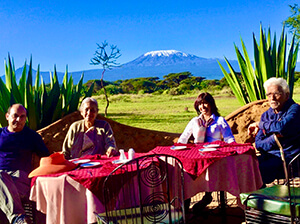
Despite not living nearby, Nita wanted to continue to continue to connect with her father. From Nita’s own words here is what she recommends:
- Build rituals that bridge the distance: Video calls a few times a week were essential, not just to check on him, but to share life with him. We created tiny rituals:
- A song we listened to together
- A poem we read aloud
- Stories about my children, my husband, family news, happy milestones.
- Celebrate from afar: On his birthday or any special occasion, I sent cakes, cards, gifts, or flowers—tangible reminders that he was cherished. Using websites on the internet made it easy to send small surprises that brought him joy.
- Strengthen emotional and social engagement: Even from afar, you can help nurture the social world around your parent:
- Organize regular virtual activities.
- Encourage neighbors, volunteers, or friends to drop by for companionship (many visited Baba just to chat or sing).
- Send care packages with familiar items, photos, and snacks that ground them emotionally.
- Love travels farther than geography: Some of the deepest caregiving happens through empathy, intention, and the quiet ways we keep showing up consistently, wholeheartedly.
So yes, you can support a parent from afar. You can be part of their emotional world. Because connection is not a place, it’s a feeling. And when you lead with love, presence travels farther than your body ever could.
Holding hands
When Nita was able to visit, not only would she spend time with her father but also working with his community. “In India, a lot of people don’t understand [the disease]. There is a negative stigma around it, they think this is a mental case. They don’t think it’s a medical issue. I worked with local people, transport people and people in stalls, I made a point to go and talk to them and explain and connect with them.”
Nita would also make sure that during her visit, her mother would get some time to herself to do what she wanted to do. Nita would take her father to hospital visits and coordinate with staff. Mostly, the two just spent time together.
“[As a young man] he used to walk through the streets walking 20 miles to see different places,” said Nita. “I’d rent a car, and take him to visit different places, his old haunts and sit by river and watch steamers going by. I’d take him to his favorite cafes and have his favorite food. When mobility got worse, just being there and holding his hand. I transformed his living area and had all his favorite artifacts and pictures surrounding him.
“When he forgot me, it was one of the saddest times for me, as I realized I was disappearing from his memory. Sometimes he would pat my head. Subconsciously he still recognized me. That’s when I realized there is inner love, we don’t need words for connection, the love itself was bridging the silence.”
“We had the deepest conversation through his eyes, his gestures, his presence, his touch, that’s when I that the memory goes but the love and emotion stay, but it’s a different way of connecting.”
The gift of CC TV
One of the other things Nita did as a long-distance caregiver was to set up closed-circuit (CC) TVs in her father’s house. This way she was assured that he was safe, comfortable and that the paid caregivers were treating him well.
When Mr. Sen Gupta died in 2021, it was during the COVID-19 pandemic and travel was not possible at that time. Nita was unable to return to India for her father’s death or his last rights. However, because of the CC TV, she had recorded the moment when he died, and she was able to rewatch that and get the closure she needed.
Connecting with the Association
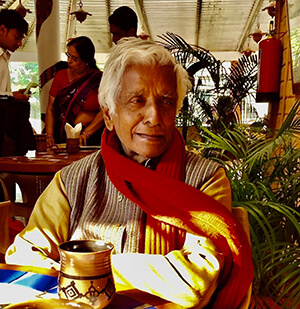
When her father was first diagnosed with dementia, Nita spent a lot of time researching the disease. Her primary source of information was the Alzheimer’s Association website. “When my father died and I wasn’t able to be there for him and also go through the last rights, I was not getting closure. I had this burning need to do something so that’s when I decided I had to get involved with the Alzheimer’s Association. They had indirectly supported me through the journey.”
As luck would have it, Nita attended a party where a friend of a friend worked for the Association. Through this connection Nita was able to get involved and is now spending her time volunteering. Nita said, “I just want to give now and that’s my way of dealing with my father’s dementia journey.”
Caregivers Across Borders
Currently, Nita is preparing to facilitate a support group specifically for caregivers like her, ones that care for a loved one in another country. This new support group, Caregivers Across Borders, starts this coming February 2026.
Support group description: Caring for a loved one with dementia is never easy, and when geography separates families, the challenges multiply. Long-distance caregiving means providing emotional, financial, logistical, and sometimes medical support from afar.
“I did not really have any guidance on long distance support when I was going through it, I needed informational and emotional guidance, and I didn’t have that kind of guidance. I got broken guidance here and there but not long-distance guidance sitting here in U.S. That’s why when [I was asked, I said,] ‘Okay I will go all out and support this.’”
Here are some things you can expect to learn in the support group:
- Health and safety
- Red flags
- Emergency planning
- Medication management
- Practical caregiving from afar
- Coordinating Care
- Best practices for remote calls
- Emotional and family dynamics
- Managing guilt and stress
- Family collaboration
- Maintaining emotional connection
“Supporting a parent from afar is one of the most emotionally complex forms of caregiving. You are close enough to feel every worry… yet far enough to feel helpless. And the world often sees only the logistics—appointments, medicines, schedules. But the real caregiving happens in the invisible spaces: the emotional threads we keep alive across the distance.
“For me, staying connected to my father’s inner world, his feelings, his essence, his humanity mattered just as much as caring for his physical needs. And that kind of connection can absolutely thrive, even when you are miles away.”
For more information on how to join the new support group, Caregivers Across Borders, call our 24/7 Helplineat 800/272/3900.
To learn more about Nita’s father, and missing the signs, please read this blog that came out last week detailing the experience.