How Personal Loss Sparked Powerful Volunteer Impact


For Volunteer Appreciation Week we are highlighting Sharon Brown, a support group facilitator and community educator for the Alzheimer’s Association®. Sharon’s lifelong caregiving led her to become a dedicated volunteer. After caring for her mother and later her aunt through dementia, Sharon gave back by fundraising, advocating for research, facilitating support groups, and educating caregivers. Today, she uses her experience to guide and support families facing Alzheimer’s and dementia.

A lifetime of caregiving
Sharon Brown has been doing some kind of caregiving all her life. As a child, her best friend was disabled, and Sharon was by his side helping him communicate with adults. When she was a young adult, Sharon’s grandfather died, and seeing her grandmother struggling with grief, she volunteered to move in and help care for her.
A few years later, Sharon continued her journey in caregiving by raising her own child. She found herself a sandwich generation caregiver, when her own mother, Nyla, began to show signs of dementia.
Approximately one-quarter of dementia caregivers are “sandwich generation” caregivers, meaning they care not only for an aging parent, but also for children under age 18.
Strange behaviors
Before Nyla’s dementia diagnosis, Sharon and her husband noticed Nyla wasn’t acting like herself. “[My mom] started acting strange, missing work and taking long lunches,” said Sharon. “Her work would call and ask, ‘Have you seen your mom?’ She was never late or missed work.”
This behavior continued for several years until Sharon’s husband suggested they take Nyla to see a doctor. Sharon wrote a letter to Nyla’s doctor explaining what symptoms they were seeing.
After an in-office test, the doctor informed them that Sharon’s mother had dementia. Sharon knew her mother wouldn’t take the news well and instead told her she had a “brain disorder,” something Nyla was more willing to accept.
Finding the Alzheimer’s Association
Sharon’s husband wanted to know more about dementia and how to better help his mother-in-law. Through research, he found the Alzheimer’s Association’s website, alz.org. He also learned there is a 24/7 Helpline (800.272.3900) that they could call for more information, which he shared with his wife.
“I called [the Helpline] and got in touch with Heather Gray, Senior Manager of Family Programs,” said Sharon. “She was our lifeline; she saved our marriage. The first thing she put me through was the Savvy Caregiver [Course]. It was an eye opener for me. [She also told me] about support groups and I went to many.”
Planning ahead
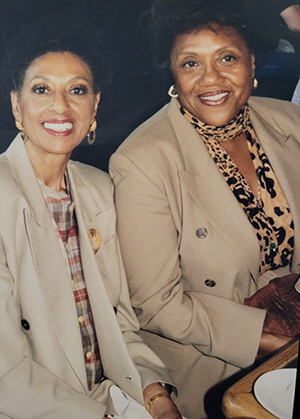
As the disease progressed, Sharon’s mother could no longer live alone. Over the next decade Sharon’s mother lived in a few different places that were better able to care for her at the level she needed.
First, she lived in a care setting where she was largely independent. Then she moved in with Sharon and her husband for a few years, while simultaneously attending an adult day program. Ultimately, Nyla moved to a care setting that could give her around the clock care.
What helped Sharon the most was planning ahead for these transitions. “Heather helped us navigate that, she told me to prepare early,” said Sharon. “You feel guilty as an only child, I’m placing mom somewhere.
“A year before I placed my mom, I went to about 25 facilities. I did research prior to selecting one and then I narrowed it down to three. I brought my husband and narrowed it down to one, so I was prepared when it was time for her to go into a facility.”
Sharon’s mother lived in that final care setting for seven years before she died in 2017 at the age of 83.
A second dementia diagnosis
Unfortunately for Sharon, her caregiving journey wasn’t over yet. After Nyla’s death, Nyla’s sister called Sharon and said, “I won a million dollars.” This instantly raised a red flag for Sharon who knew it was a scam.
Sharon quickly saw that her aunt was having similar memory problems as her mother, especially when it came to money. Sharon spent the next seven years caring for her aunt and making sure she was safe and comfortable until her death in 2024.
Finding her calling
Sharon has been incredibly involved with the Association in different ways since her mother’s diagnosis in 2000. She’s been engaged and actively participated in:
- Participating in Walk to End Alzheimer’s
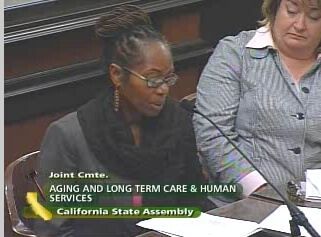
- Testifying at the state capitol to continue Alzheimer’s research funding
- California state Advocacy Day
Now that she has retired, Sharon wanted to do even more. She called Heather and asked to become a support group facilitator. “I wanted to help, I wanted to give back,” said Sharon. “I’m so happy I’m in my element I love doing this and I want to do more.”
After spending time with support groups, Sharon knew she had more to give. She reached out to Heather again and stepped into the role of community educator, leading her first education program in February 2026.
“Once I’d gotten to be a facilitator, [it was like] I’d died and gone to heaven,” said Sharon. “So many people out there that don’t know how to handle this [disease], the person you love is acting strange, it’s very confusing for individual caregivers.
“I thank the heavens for Heather and the Alzheimer’s Association for getting me through that first period. They prepared me for that first step and counseled me. I can share that with the people I facilitate for. It’s rewarding to see the information you share with people, that they are able to use it – that’s a reward in itself.
You can become an Alzheimer’s Association volunteer by visiting alz.org/ volunteer.
For more information on our upcoming education programs and support groups visit alz.org/crf or call our 24/7 Helpline at 800.272.3900.