3-mile goodbye


By Nancy Rolnik, MD
It was early January. My sister, local to the memory center where my mom “Dolly” lived, texted our sibling group chat that mom had become more aggressively agitated and confused. The staff called it terminal agitation syndrome.
As a doctor, I’ve heard of a lot of things but that was never one of them. I always wondered how Alzheimer’s could kill someone, but this was happening right now and I quickly learned — the brain starts shutting down. We quickly planned a Zoom call so all four kids could talk about what was happening. With my awareness of end-of-life options, I realized that hospice was the likely next step.
When the hospice team evaluated my mom they said she had 7 to 10 days left to live, which was typical once terminal agitation syndrome began. I was at home in California and my mom was in the suburbs of Atlanta. I always hated that she was so far away, a five-hour flight plus a three-hour time zone change. It made it hard to make quick weekend trips to visit her.
Time was of the essence, so I quickly hopped on the United app and found a good last-minute award seat to get to Atlanta right away. I really didn’t know what to expect but I knew she had been sedated. The sad truth is she was fully sedated with no capacity to communicate or even show awareness when I arrived.
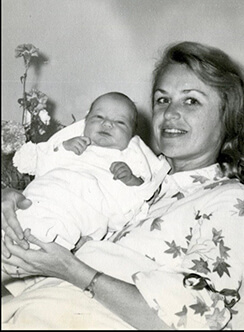
She was so thin, yet she was still my mom and had beautiful hair, silvery gray chin length with a nice wave. My mom was naturally beautiful and didn’t go to heroics to accentuate that beauty. I sat with her, holding her skinny hand, and talked to her like she could hear me. I hoped that she could. I told her I was there for her and how much I loved her and hoped that she would open her eyes but just for a minute. That never happened.
A few hours after I arrived, my younger sister arrived from Chicago. We sat with her and talked amongst ourselves realizing, of course, the end was near. There was a pullout chair that my sister laid down on and after midnight, she closed her eyes.
I didn’t want to go to sleep, so I stayed up until about 3 or 4 a.m. when I decided maybe I should scrunch down in my chair and prop my feet up on my mom’s bed to try to get just a little bit of rest.
A short few hours later her nurse came in to check on my mom, and I asked her if we could hold the morning sedative. She was going to check with the doctor. I closed my eyes again. That issue was a moot point because within an hour my mom stopped breathing.
In my career, I’d seen few patients at the moment of death. My first patient who died (I didn’t witness her death) died of melanoma. I cried and felt exhausted. As a first-year resident, I had more time to spend talking with her and getting to know her, and it really hurt when she died. I chose a field where I wouldn’t see death in kids or adults. My emotions just couldn’t hack that level of pain.
But this was my mom. Quiet. Oh so thin. Lying there in her nightgown. She was gone.
A few weeks after her funeral, I learned about the Alzheimer’s Association Walk to End Alzheimer’s® in San Francisco and I thought that would be a really positive thing to participate in to honor my mom and her life. I asked my younger sister if she would join my team remotely from Chicago, and she said, not yet, that it was too soon to even think about fundraising or doing an event. I didn’t even ask my other siblings.
For some reason, philanthropy has always been something I’ve participated in, and this time it was personal. I wanted to do something positive in my mom’s memory. I knew she was never coming back, but somewhere there was a daughter watching her mother quietly disappear, and maybe she could get support from the Alzheimer’s Association free 24/7 Helpline (800.272.3900). And also, money could go towards finding a cure or teach people about preventative habits.
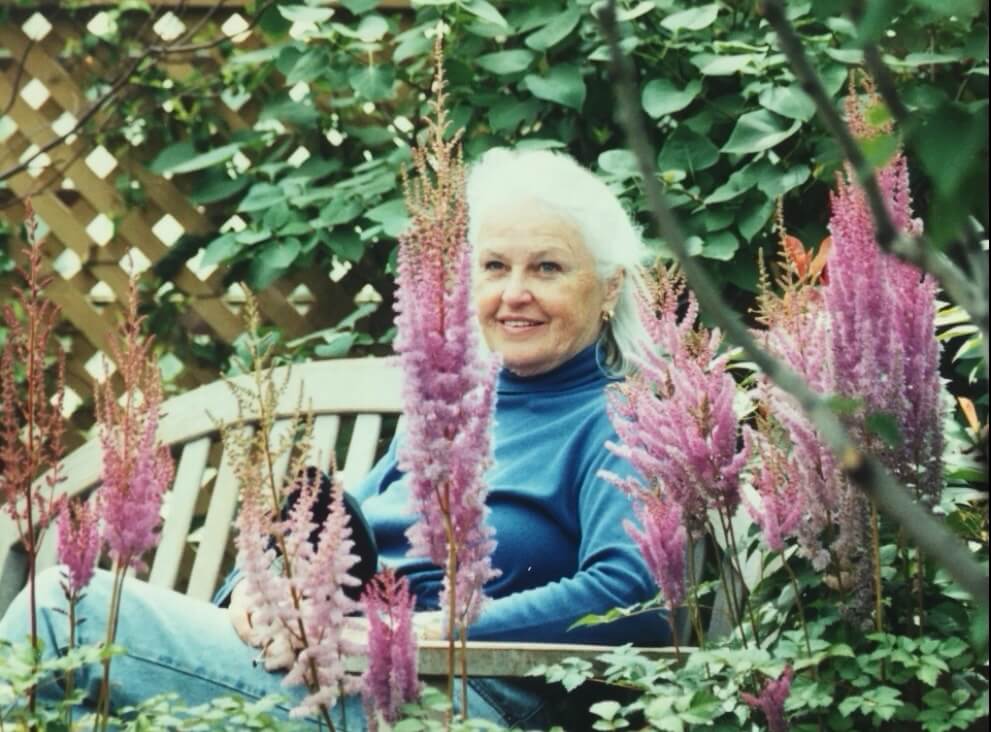
My mom gave me a lot of great things, like my love of nature, flowers, animals, my smile and the gift of gab. But unfortunately, I also inherited a gene called the ApoE4 gene that can be passed down through generations, increasing my risk of developing Alzheimer’s threefold. I feel fortunate I don’t have two of these genes which would increase my risk by 10 times. I’m determined to either push back an Alzheimer’s diagnosis or avoid it altogether with health strategies I adopt every day.
So yesterday I walked in the Walk with my two teenagers and my husband. I invited others to join, but it was just the four of us, which was perfect. My daughter is in college and I asked her if she would come home for this Walk, and she gladly agreed. My often naysaying son, without hesitation, also agreed to participate in the Walk. I can’t tell you how happy that made me.
So yesterday morning at 7 a.m., I woke up, steamed my championship long-sleeve purple shirt I had earned from raising a good amount of money and gave my daughter the Walk to End Alzheimer’s purple shirt that I had also received.
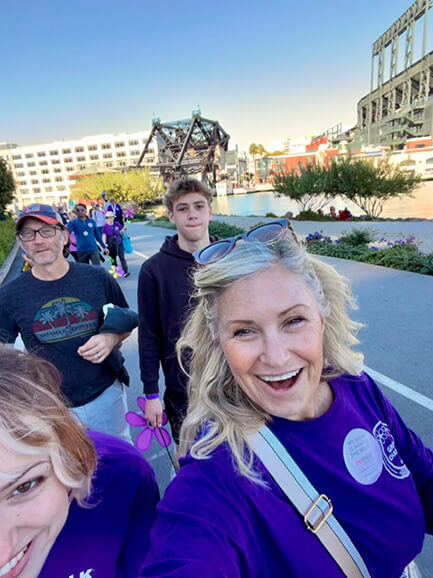
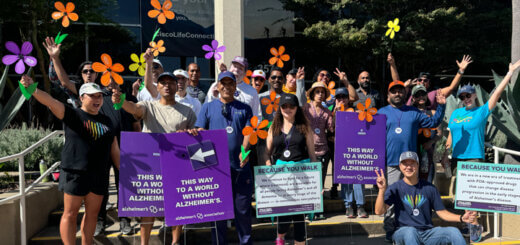
We headed down to San Francisco, stuck in a bunch of traffic on the Bay Bridge, but we arrived in time to hear the MC announcing the Promise Garden flowers. Each flower color represented a different category of participant from the person who was an advocate for Alzheimer’s, to those who are living with Alzheimer’s, to those supporting someone with Alzheimer’s, and then those who had lost someone to Alzheimer’s — that was the purple flower we all carried. It was a pinwheel, and there was enough breeze to make them rotate and brighten up the walk.
The volunteers cheered and rang bells as we walked by, not nearly as exciting as when I ran the Chicago Marathon where there were bands and lots of hoopla, but I was really happy to have the cheering and positive signs they held.
We four walked and talked and bonded over the hour it took to walk the three miles. Ahead of us were three older women linked hand in hand, walking together. That brought a smile to my face. Lots of families, some dogs, some strollers and some older folks participating with a lot of joy and celebration for those affected by Alzheimer’s.
I want to thank the Alzheimer’s Association for putting on such a cheerful event surrounding such a sad, sad disease. I fight every day for my brain health.
I cried at the Walk, but also laughed with my family who I love beyond words. My goal is to focus on brain health and do what I can to stop the generational pain. I won’t forget them! At least that’s my hope!
It’s not too late to support Walk to End Alzheimer’s! You can make a donation to Nancy’s team, Be Adventure Ready, or visit alz.org/Walk and donate to a Walk near you. Fundraising continues through December 31, 2027.
Learn more about brain health at alz.org/brainhealth.