Tag Alzheimer’s research

Exciting Science From This Year’s Researchers Symposium!

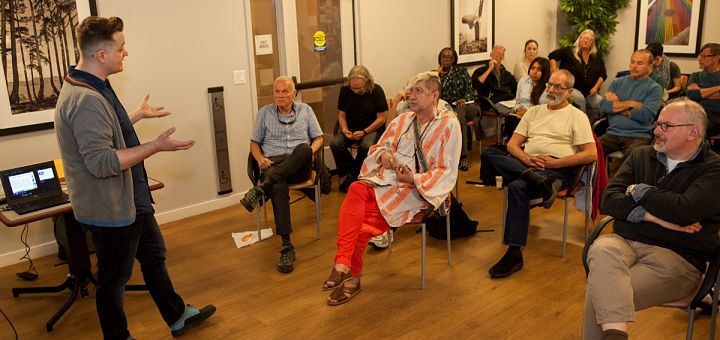
XraysAbout 100 Alzheimer’s Scientists gathered Monday at the Alzheimer’s Association Researchers Symposium. This annual event is organized by the volunteer Medical and Scientific Advisory Council of the Alzheimer’s Association, Northern California and Northern Nevada Chapter. It brings together researchers from across our Chapter to share ideas, present new data, network and celebrate young researchers.

This year, we held the Symposium at UC Berkeley and heard from scientists who address research in the areas of the ApoE Alzheimer’s risk gene, network dysfunction and new ideas in clinical trials. There were two presentations I found particularly interesting during this year’s event. Continue reading “Exciting Science From This Year’s Researchers Symposium!” »

Behind the scenes at the 25th Annual Alzheimer’s Association Advocacy Forum – Day 3

After two days of inspiration and education, advocates headed to Capitol Hill to meet with their respective legislators and ask for their continued support in the fight against Alzheimer’s.  Here’s how the meetings went for a few of the Northern California and Northern Nevada Chapter advocates:

View photos from the forum on Flickr and learn more about the sessions at alz.org/forum.

Behind the scenes at the 25th Annual Alzheimer’s Association Advocacy Forum – Day 1

Over 900 Alzheimer’s advocates have gathered in Washington, D.C. for the 25th Annual Alzheimer’s Association Advocacy Forum. We have asked attendees from the Northern California and Northern Nevada Chapter to share their insights from the sessions they have attended. Here is what they had to say on Day 1:

View photos from the forum on Flickr and learn more about the sessions at alz.org/forum.

25 Years of Making our Voice Heard: Let 2013 be the Year of Real Change

Alzheimer's ForumOn April 22, volunteers from around the country will convene in Washington, D.C. for the 25th Alzheimer’s Association Advocacy Forum — the nation’s largest Alzheimer’s policy event. Since 1989, dedicated Alzheimer’s advocates have met annually to share their personal experiences, learn about legislative initiatives, celebrate policy efforts and urge elected officials to make Alzheimer’s disease a national priority. This year a record number of advocates are slated to attend. As the Association’s new volunteer ambassador to the office of Senator Dianne Feinstein, I will attend the Forum for the first time.

Expectations are high that the 25th Forum will make a meaningful difference in the fight against Alzheimer’s, and there’s good reason for optimism. Recent advocacy efforts have produced important results, chief among them the passage of the National Alzheimer’s Project Act and the release of the first-ever National Alzheimer’s Plan. The fight against Alzheimer’s was in the national spotlight earlier this year, when President Obama mentioned Alzheimer’s disease in his State of the Union address, underscoring the critical need for medical research to address Alzheimer’s and other dementias. Continue reading “25 Years of Making our Voice Heard: Let 2013 be the Year of Real Change” »

Delirium or Dementia – Do you know the difference?

What do we mean by delirium?

Also called the acute confusional state, delirium is a medical condition that results in confusion and other disruptions in thinking and behavior, including changes in perception, attention, mood and activity level. Individuals living with dementia are highly susceptible to delirium. Unfortunately, it can easily go unrecognized even by healthcare professionals because many symptoms are shared by delirium and dementia. Sudden changes in behavior, such as increased agitation or confusion in the late evening, may be labeled as “sundowning” and dismissed as the unfortunate natural progression of one’s dementia.

When is a change in behavior delirium and not part of dementia?

In dementia, changes in memory and intellect are slowly evident over months or years. Delirium is a more abrupt confusion, emerging over days or weeks, and represents a sudden change from the person’s previous course of dementia. Unlike the subtle decline of Alzheimer’s disease, the confusion of delirium fluctuates over the day, at times dramatically. Thinking becomes more disorganized, and maintaining a coherent conversation may not be possible. Alertness may vary from a “hyperalert” or easily startled state to drowsiness and lethargy. The hallmark separating delirium from underlying dementia is inattention. The individual simply cannot focus on one idea or task. Continue reading “Delirium or Dementia – Do you know the difference?” »

Think It Over…

While the Alzheimer’s Association is proud be to the largest private, non-profit funder of Alzheimer’s research, most basic science in the U.S. is funded through the National Institutes of Health.

Currently, the NIH funds about $6 billion in cancer science, $5 billion in heart disease research and a little over $3 billion in HIV/ Aids science. The Feds provide just under $500 million for Alzheimer’s research. I work for the Alzheimer’s Association and I have lost three family members to Alzheimer’s; I’m biased, but I think these numbers are out of whack.

It’s not that I begrudge these important public health issues a nickel. I’m delighted death rates from cancer, heart disease and HIV are bending downward. But $500 million for Alzheimer’s research just won’t alter the future fast enough for our children or grandchildren. This level of funding will assure that nearly half of today’s Boomers will spend the last years of their lives in the fog of Alzheimer’s.

I take this spending allocation as an expression of public focus. I ask myself, why this huge discrepancy? I think some of it is an unspoken cost-benefit analysis that says, “these people are about done anyway and society needn’t spend huge dollars on this cohort.” Many people still think of Alzheimer’s as normal aging and the medical community often doesn’t help. Over half of the more than 5 million Americans with Alzheimer’s will never be diagnosed. I frequently run into people who tell me that mom didn’t have Alzheimer’s, “she had dementia.” If you don’t think Mom had Alzheimer’s, are you going to care about Alzheimer’s research funding levels?

Some of the problem is stigma. It’s one thing to note that your backhand isn’t what it once was; it’s a very different thing to say you don’t think as well as you used to. We hum along on what is between our ears and when that is compromised, it has a whole different meaning to our future. It scares us, and it doesn’t help that there are no survivors showing up at Alzheimer’s fundraisers.

We must and will do better. It’s a matter of how fast we get to it. This Spring, the Association will mount a new public awareness campaign to help change the conversation. Let us know what you think and most importantly, share the message with your community.

Wm H. Fisher, wfisher@alz.org

Copyright © 2013 Alzheimer's Association. All Rights Reserved.

Through this website you are able to link to other websites which are not under the control of the Alzheimer’s Association. We have no control over the nature, content and availability of those sites. The inclusion of any links does not necessarily imply a recommendation or endorse the views expressed within them.

Chapter Headquarters
Alzheimer's Association of Northern California and Northern Nevada
1060 La Avenida, Mountain View, CA 94043 Phone 650.962.8111

National Headquarters
Alzheimer's Association National Office 225 N. Michigan Ave., Fl. 17, Chicago, IL 60601 Alzheimers and Dementia Blog – Alzheimers Association of Northern California and Northern Nevada

Built on Notes Blog Core
Powered by WordPress